
 1300 006 263

How Do I Get a Domain Name for My Business?
The world today runs online – from listening to music, reading newspapers, booking a table at a restaurant, shopping, planning a holiday – you name any activity, and all you have to do is pull out your smartphone for it.
Hence, if you are starting a business or already have an on-premises one, you miss out on a significant chunk of potential customers if you do not have a website up and running. And the first step that you need to take is to have a domain name for your website.
Do not get put off by the thought. Registering for a domain name might sound quite complex, but it is pretty simple.
This guide on how to get a domain name for your business will take you through a comprehensive checklist, starting from what is a domain name, types of suffixes, the cost of getting one, how to choose the right domain name, and more though not necessarily in this order.
So, let’s dive into the various aspects that govern how to get a domain name for your business.
What is a Domain Name?
Every website on the Internet has a unique IP address that determines its location. This address is generally a string of numbers and looks somewhat like this, for example – 232.54.96.169.
Now think of all your customers desperately trying to recall these numbers to get to your website, and you will understand how difficult the task will be. This is where a Domain Name comes into the picture.
When the IP address is transformed into an easy-to-remember format through a structure called the Domain Name System (DNS), it is called the Domain Name. This name will guide customers to your website and one they will enter in their browsers. When a domain name is typed into a browser, it reaches the DNS server, which then translates the name to the specific IP address it is linked to. This process hardly takes a few seconds, and your client can quickly find your website.
Types of Domain Names
Hundreds of millions of domain names are registered worldwide, and what you buy depends on your specific style and nature of business. But before purchasing a domain name, you need to understand the anatomy of the domain name.
There are two essential components of a domain – second-level domains and top-level domains.
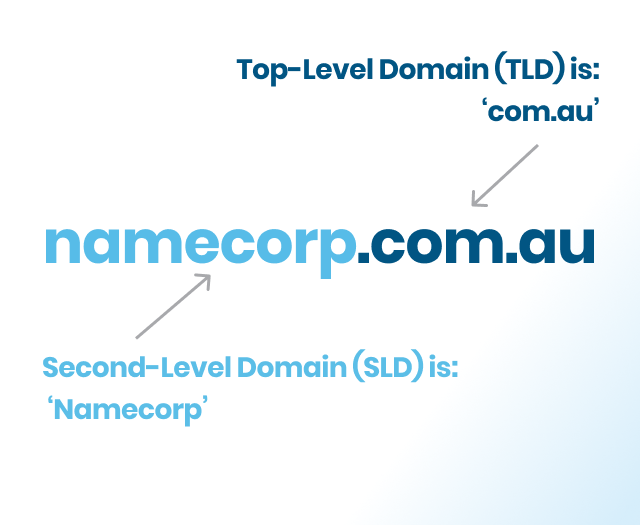
Second-Level Domains (SLDs)
A second-level domain is what people instantly recall when they think of your business. It is the exclusive name that you have selected to represent your brand, product, or services that will be remembered the most. An SLD is located just to the left of an extension or the top-level domain in a web address.
While keeping the SLD as precise and straightforward as possible for quick recall is preferable, there is no limit to the number of letters, numbers or special characters that can be used here.
Top-Level Domains (TLDs)
Top-Level Domains (TLDs) are also known as domain extensions and are the series of letters that are seen after the SLD and the dot.
The main ones are –
- .com: Added in 1985, this is the most common extension in the Domain Name System of the Internet. The ‘com’ is a derivative of the word “commercial” and indicates the original intended purpose of your business. However, this extension has now been opened for general purposes too.
- .org: This extension was also one of the original domains established in 1985 and looked upon as more robust than the newer alternatives. It is a derivative of the word “organisation” and is mainly used for non-profit websites like educational platforms, NGOs, and charities.
- .net: This TLD is a derivative of the word network. Businesses with this extension are generally involved in networking technologies like internet service providers and companies providing similar infrastructure facilities. General business websites of all types now use it.
- .edu: This TLD was created for U.S. educational and academic institutions and even today is associated with most schools. This extension is a short form of “education”.
- .gov: This extension is restricted for use by government entities. Countries typically add a second-level domain for operations in their country. For example, gov.au is the domain of the Government of Australia.
Apart from these primary extensions, there are other niche extensions, like .coffee or .ninja. These could be quite catchy for a coffee shop or a martial arts studio! However, you need to think about whether that is right for your brand, as most businesses opt for traditional extensions. In all, there are currently about 1,500 different extensions, and the list continues to grow exponentially.
The price of buying a domain name depends on the choice of extension, as some carry more weight than others. While choosing a domain name, pick one that closely represents your business niche with an extension that is easy to recall.
Domain Name Cost
Generally, domain names bought through domain registrars are valid for a year only though you can opt for several years at a time. Once the specified term is over, you will be alerted by the registrars to renew the domain name. Sometimes, the cost of the domain name is also included in your web hosting plan, but when not so, it is usually provided by the hosting company.
At Namecorp the cost of the domain name depends on the TLD selected by you, such as .com or .net. A common TLD like .com can be bought for $99 for a two year registration term, and includes free website design by a specialist team with our hosting plans.
Along with the domain name, we also provide WHOIS privacy protection and a Secure Sockets Layer (SSL) certificate so that you get verification and encryption for added website security.
It is not necessary to have hosting to buy a domain name though you need hosting to bring your site online. However you can buy your domain name to reserve the name. Then take your time to build your website.
If you have your business name in mind you can set up your ABN, and business name and reserve your domain name in one easy application with Namecorp.

Domain Name Registration
-jpg-1.jpeg)
How to Register the Domain Name
Now that you know what a domain name is, the types of domain names, and the cost of registering one, your natural question would be – how do I register a domain name for my business?
For registering a domain name, all that is required is an ABN (Australian Business Number) number. It is a unique identifier issued by the Australian Business Register and consists of 11 digits. The law requires that every business entity in Australia has an ABN that will be shown on tax invoices and tax-related documents issued by the business. In order to apply for an ABN you will need a tax file number (TFN).
Application for an ABN can be through an online portal of the Australian Business Register, via the services of a registered tax agent, or by lodging a paper-based application with the ATO.
At Namecorp we can apply for an ABN and domain name for you in one easy application.
Verifying Domain Name Ownership
Having the domain name registered is only half the story, the next step of verifying ownership of the domain is equally important. This step allows you to send an email with the new domain name and stops others from using it without your permission.
This process is simple when you purchase your domain from Namecorp. We will send you a verification mail after the purchase is completed. Click the Verify Domain button in the email and follow the instructions to confirm the purchase of your domain name ownership.
Whether working on an online portfolio, or any other website, Namecorp offers customised domains that will enhance your online presence. We can help you register your ABN and domain name in one easy application.
Download our quick checklist for making sure you’ve covered all bases when setting up your domain name.

Disclaimer: All information provided on this webpage is general information about our business in Australia, and products and services. Nothing on this webpage is intended to be professional advice and should not be relied on as such. You should obtain specific financial, legal, or other professional advice before relying on the content of this webpage. By not seeking such advice, you accept the risk that the information on this webpage may not meet the specific needs of your business. Our liability is limited to the maximum extent permitted by applicable law in accordance with our website terms and conditions.


